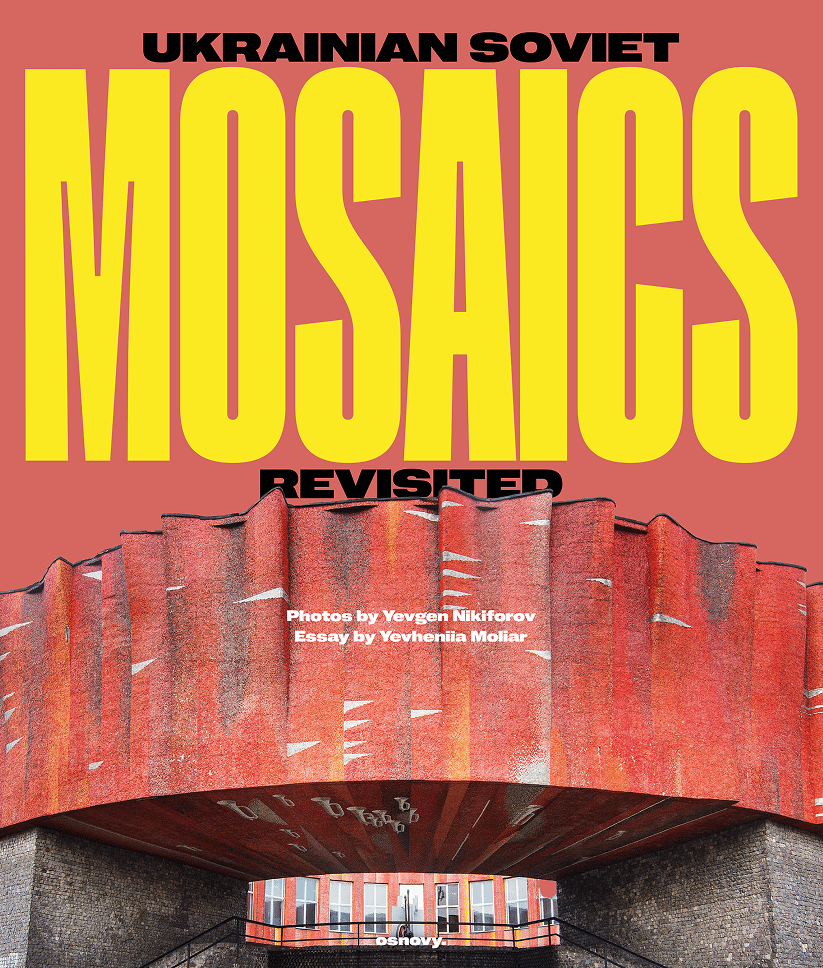

Ukrainian Soviet Mosaics. Revisited
Немає на полицях
Немає на полицях
Опис
Ukrainian Soviet Mosaics. Revisited is a large-format photobook by Yevgen Nikiforov that presents mosaics created in Ukraine during the Soviet period. The volume also includes a cultural essay by Yevgenia Molyar, which situates these works within a broader historical and social context.
What the volume offers is at once a visual archive — priceless in its breadth, documenting works preserved, vandalized, or vanished between the 1960s and the 1980s — and an inquiry into questions that continue to trouble the very marrow of our identity. The pages teem with the shimmering tesserae of Alla Horska, Ivan Lytovchenko, Valerii Lamakh, Halyna Zubchenko, Ernest Kotkov, among many others, each name a fragment in a fractured mosaic of its own.
But what, precisely, do we see when we look at these walls of color and glass? Monuments enlisted in the service of totalitarian propaganda and colonial subjugation, or vessels that smuggled, against all odds, something distinctly Ukrainian, something obstinately luminous? Can such an essence be disentangled from the Soviet frame that contained it? And what, finally, does the present moment — haunted by the twin specters of decommunization and decolonization — teach us about how to read, to keep, or perhaps to let go of this heritage?
For Nikiforov, the project began with a private fascination that grew into a decade-long devotion. Over twelve years, he traversed the country’s vast geography, from provincial towns to remote villages, assembling a photographic archive of over six thousand works. A portion of this trove appeared in Decommunized: Ukrainian Soviet Mosaics (Osnovy, 2017). The present volume gathers images never before published, unveiling newly discovered sites and offering, with quiet insistence, the possibility of seeing again — of seeing differently — what had long been hidden in plain sight.